containerization-and-devops
Class 9 Part 2 - Reverse Proxy with Nginx
Objective
This experiment demonstrates horizontal scaling using Docker Compose
with a reverse proxy (Nginx).
Multiple WordPress containers are deployed and traffic is routed through
Nginx as a single entry point.
Architecture Overview
Browser
↓
Nginx (Port 8080)
↓
WordPress (3 Replicas)
↓
MySQL Database
This setup implements a 3-tier architecture:
- Presentation Layer → Nginx\
- Application Layer → WordPress (Scaled)\
- Database Layer → MySQL
docker-compose.yml
services:
  mysql:
    image: mysql:8.0
    container_name: class9_mysql
    environment:
      MYSQL_ROOT_PASSWORD: secret
      MYSQL_DATABASE: wordpress
      MYSQL_USER: wpuser
      MYSQL_PASSWORD: wppass
    volumes:
      - mysql_data:/var/lib/mysql
    networks:
      - wordpress-network

  wordpress:
    image: wordpress:latest
    expose:
      - "80"
    environment:
      WORDPRESS_DB_HOST: mysql
      WORDPRESS_DB_USER: wpuser
      WORDPRESS_DB_PASSWORD: wppass
      WORDPRESS_DB_NAME: wordpress
    volumes:
      - wp_content:/var/www/html/wp-content
    depends_on:
      - mysql
    networks:
      - wordpress-network

  nginx:
    image: nginx:latest
    ports:
      - "8080:80"
    volumes:
      - ./nginx.conf:/etc/nginx/nginx.conf
    depends_on:
      - wordpress
    networks:
      - wordpress-network

volumes:
  mysql_data:
  wp_content:

networks:
  wordpress-network:
nginx.conf
events {}

http {
    upstream wordpress {
        server wordpress:80;
    }

    server {
        listen 80;

        location / {
            proxy_pass http://wordpress;
            proxy_set_header Host $host;
            proxy_set_header X-Real-IP $remote_addr;
        }
    }
}
Scaling Command Used
docker compose up -d --scale wordpress=3
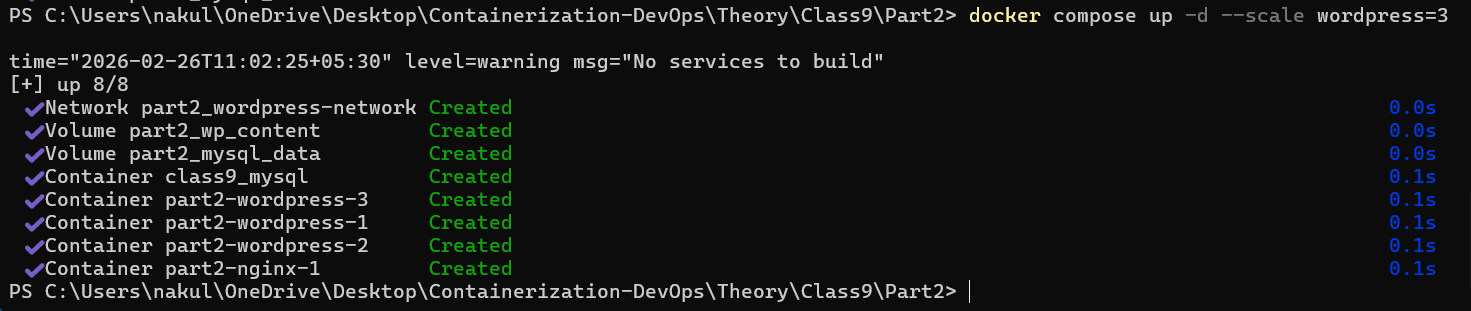
Output Observed
Containers Created:
- class9_mysql\
- part2-wordpress-1\
- part2-wordpress-2\
- part2-wordpress-3\
- part2-nginx-1
Docker automatically created:
- Network → part2_wordpress-network\
- Volumes → part2_mysql_data, part2_wp_content
Key Concepts Learned
- Why port conflicts happen when scaling with fixed ports\
- Difference between
portsandexpose\ - Horizontal scaling using
--scale\ - Reverse proxy architecture\
- Docker internal DNS resolution\
- Load balancing using Nginx upstream
Conclusion
This experiment successfully demonstrated:
- Horizontal scaling of application containers
- Reverse proxy configuration using Nginx
- Service isolation using Docker networks
- Production-style container architecture
The system now follows a scalable multi-container design where only Nginx is publicly exposed and WordPress replicas are internally load balanced.